
Category: Connectivity

  • M2M Data Connect Group Shortlisted for Technology Provider of the Year at Taxi Summit Awards

    M2M Data Connect Group Shortlisted for Technology Provider of the Year at Taxi Summit Awards

    M2M Data Connect Group has been shortlisted for the Technology Provider of the Year award at the upcoming Taxi Summit, taking place this November at the iconic Blackpool Tower. This nomination celebrates over ten years of commitment to powering the taxi and private hire industry with reliable, scalable, and future-ready connectivity solutions.

    For more than a decade, M2M Data Connect has led the way in mobile connectivity for transport and mobility. Our technologies support SIM provisioning, multi-network orchestration, and smart connectivity management that keeps fleets compliant and connected across the UK and beyond.

    Through partnerships with leading software providers, our systems integrate seamlessly with booking platforms, enforcement tools, payment gateways, and dispatch platforms. M2M Data Connect technology helps operators move beyond simple connectivity to achieve intelligent, data-driven operations.

    One of the innovations driving this nomination is M2M TaxiBot, our WhatsApp-based conversational assistant. Built on the M2M Omnichannel Platform, TaxiBot allows passengers to book, pay, and manage taxi journeys through everyday messaging apps, removing friction from the booking process and improving customer satisfaction.

    The Taxi Summit Awards recognise excellence across the UK taxi and private hire ecosystem. Being shortlisted for Technology Provider of the Year places M2M Data Connect among the industry’s leading innovators shaping the future of mobility.

    We look forward to joining industry professionals at Blackpool Tower on Tuesday, 19 November, and continuing to deliver secure, scalable, and intelligent connectivity for fleets worldwide.

  • Solar Farm IoT: Unlock Efficiency with Smart Connectivity

    Solar Farm IoT: Unlock Efficiency with Smart Connectivity

    Empowering Solar Farms with Smart IoT Connectivity

    As the world accelerates toward a clean energy future, solar farms are playing a pivotal role in meeting global sustainability goals. But with scale comes complexity. Managing vast arrays of solar panels across remote locations requires more than just manpower—it demands intelligence, automation, and real-time insight. That’s where IoT connectivity steps in.

    What Is IoT Connectivity in Solar Farms?
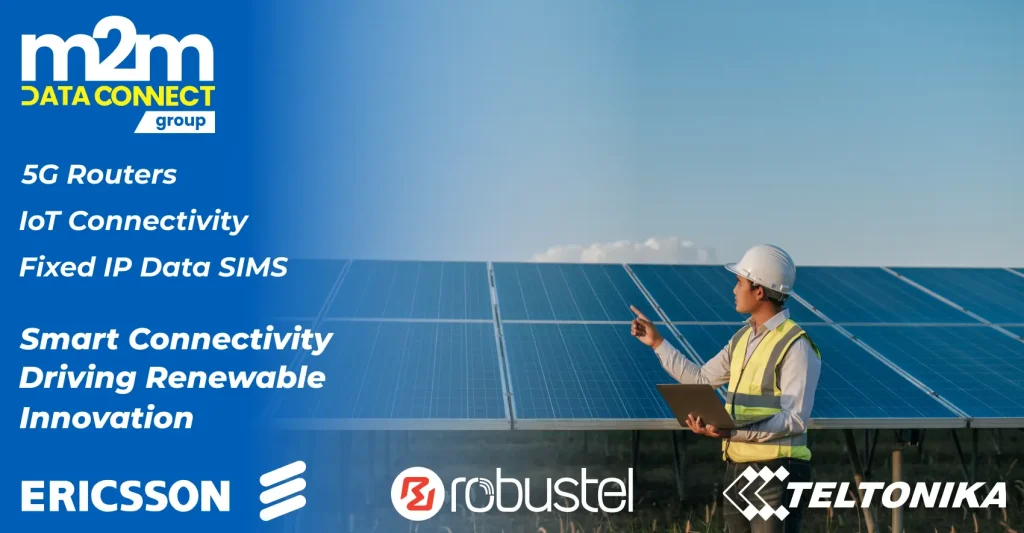

    IoT (Internet of Things) connectivity refers to the network of smart sensors, devices, and communication systems that collect, transmit, and analyze data from solar farm operations. These systems enable operators to monitor performance, detect issues, and optimize energy output—all in real time.


    Get A Quote

    Key Applications of IoT in Solar Farms

    1. Real-Time Performance Monitoring

    IoT sensors continuously track metrics such as:

    • Solar irradiance

    • Panel temperature

    • Voltage and current output

    • Inverter efficiency

    This data is transmitted to cloud-based dashboards, giving operators a live view of system health and performance.

    2. Predictive Maintenance

    Instead of waiting for equipment to fail, IoT systems use historical and real-time data to predict when components like inverters or panels are likely to degrade. This reduces downtime and maintenance costs.

    3. Remote Management

    IoT-enabled solar farms can be managed from anywhere. Operators can:

    • Adjust settings remotely

    • Receive alerts for anomalies

    • Schedule maintenance without site visits

    This is especially valuable for farms in remote or hard-to-reach areas.

    4. Energy Forecasting & Grid Integration

    By combining IoT data with weather forecasts and AI models, solar farms can predict energy output and adjust operations accordingly. This helps balance supply with demand and improves integration with the power grid.

    5. Security & Safety Monitoring

    IoT cameras and motion sensors can detect unauthorized access or physical damage. Environmental sensors can also monitor for fire risks, overheating, or electrical faults.


    Connectivity Technologies That Power IoT in Solar Farms

    • 5G: Offers high-speed, low-latency communication for real-time data transmission.

    • LPWAN (Low Power Wide Area Networks): Technologies like LoRaWAN and NB-IoT are ideal for transmitting small amounts of data over long distances with minimal power usage.

    • Edge Computing: Enables local data processing at the device level, reducing the need for constant cloud communication and improving response times.

    Sustainability Meets Smart Technology

    IoT connectivity doesn’t just make solar farms more efficient—it makes them more sustainable. By optimizing energy output, reducing waste, and minimizing manual intervention, IoT helps solar farms deliver cleaner energy with a smaller environmental footprint.


    The Future of Solar Energy Is Connected

    As solar technology advances, IoT will become even more integral to its success. From AI-driven analytics to autonomous maintenance drones, the possibilities are vast. For solar farm operators, embracing IoT is no longer optional—it’s essential for staying competitive, sustainable, and future-ready.


    Ready to harness the power of IoT for your solar farm? Let’s talk about how smart connectivity can transform your energy operations.

  • M2M Smart Highways: IoT Multi-Network Traffic Solutions

    M2M Smart Highways: IoT Multi-Network Traffic Solutions

    Building Smarter Highways with M2M Data Connect and Multi-Network IoT Connectivity

    Smart highways are redefining transportation by integrating Machine-to-Machine (M2M) Data Connect and multi-network IoT connectivity to optimize traffic flow, enhance safety, and improve infrastructure efficiency. By utilizing multiple communication channels—cellular, satellite, LoRaWAN, and fiber optics—these highways ensure reliable, scalable, and adaptive data exchange across critical systems.

    The Power of M2M Data Connect in Smart Highways

    M2M technology enables direct device-to-device communication, allowing infrastructure components such as traffic sensors, smart toll systems, autonomous vehicle networks, and surveillance cameras to interact seamlessly without human intervention.

    Get A Quote

    How Multi-Network IoT Enhances Highway Connectivity

    1. Uninterrupted Traffic Management & Monitoring

    Smart highways rely on real-time IoT data for dynamic traffic optimization. Multi-network IoT SIM cards ensure continuous connectivity between:

    • AI-driven traffic control centers

    • Connected vehicle navigation systems

    • IoT-powered road sensors monitoring congestion

    2. Vehicle-to-Infrastructure (V2I) Communication for Smart Mobility

    M2M and multi-network IoT enable vehicles to communicate directly with road infrastructure, supporting: Real-time route optimization based on congestion levels🚦 Adaptive traffic signals that adjust to vehicle density Emergency response prioritization for faster assistance

    3. Smart Tolling & Contactless Payments

    With M2M-enabled IoT connectivity, toll systems can seamlessly process transactions across multiple networks, enabling: Automated toll payments without manual intervention🔄 Dynamic pricing models based on real-time traffic conditions Remote verification via multi-network SIM cards for uninterrupted service

    4. Predictive Maintenance & Infrastructure Longevity

    Smart highways feature embedded IoT sensors in roads, bridges, and tunnels that transmit health data via M2M connectivity across multiple networks. This enables predictive maintenance, preventing costly infrastructure failures and improving long-term highway efficiency.

    5. AI-Driven Surveillance & Security Optimization

    Smart CCTV and traffic enforcement systems leverage multi-network M2M data transmission to: Detect accidents, road hazards, and violations in real time🔄 Seamlessly switch between networks to prevent surveillance blackouts Transmit alerts instantly to traffic control centers and emergency responders

    6. Edge Computing & Cloud Integration for Smart Highway Data Processing

    Multi-network IoT connectivity supports edge computing solutions, ensuring real-time highway data processing without relying on a single cloud provider. This reduces latency and enhances high-speed decision-making for autonomous vehicle coordination.

    The Future of Connected Highways

    As urban mobility advances, M2M and multi-network IoT will drive innovations such as: Fully autonomous vehicle ecosystems🌍 Decentralized AI-powered traffic coordination Energy-efficient smart roads with dynamic charging stations

    Smart highways are not just roads—they are intelligent transportation hubs, built for a future of seamless mobility, enhanced safety, and optimized urban efficiency.

    Explore specific IoT use cases like satellite connectivity, edge AI, or autonomous vehicle integration get in touch today and request a quote

  • IoT CCTV with M2M: Smarter, Uninterrupted Surveillance

    IoT CCTV with M2M: Smarter, Uninterrupted Surveillance

    Enhancing CCTV Security Systems with IoT Connectivity and M2M Data Connect.

    As security threats grow more sophisticated, traditional CCTV surveillance is evolving into intelligent, proactive monitoring systems powered by IoT connectivity and Machine-to-Machine (M2M) Data Connect. By integrating these technologies, CCTV networks can achieve real-time communication, automated security responses, and uninterrupted operation, even in remote or high-risk areas.

    Get A Quote

    Why M2M Data Connect Matters for CCTV Security

    M2M Data Connect ensures that CCTV systems remain connected even when traditional networks fail. This enables seamless communication between security cameras, control centers, and other IoT devices—critical for uninterrupted surveillance in urban, industrial, and remote environments.

    How IoT and M2M Connectivity Elevate CCTV Security

    1. Uninterrupted Surveillance with Multi-Network Support

    M2M connectivity allows CCTV systems to switch between mobile networks, satellite, LoRaWAN, or Wi-Fi to maintain a stable connection at all times. This ensures real-time monitoring, even in areas with poor network coverage or high interference.

    2. AI-Driven Threat Detection & Automated Alerts

    IoT-powered security cameras analyze footage using AI algorithms to detect suspicious behavior, unauthorized access, or potential threats. When an anomaly is detected, M2M connectivity ensures instant alerts are sent to security teams, mobile devices, or emergency responders, triggering automated security protocols.

    3. Predictive Maintenance for Maximum Uptime

    IoT sensors within CCTV cameras track hardware health, temperature changes, and connectivity status. M2M-enabled devices transmit this data in real time, allowing predictive maintenance to prevent failures before they occur—ensuring continuous surveillance with minimal downtime.

    4. Secure and Scalable Access Control

    With M2M Data Connect, security systems can integrate with biometric authentication, keyless access, and remote door controls. IoT-connected cameras verify credentials and trigger automated responses, securing restricted areas while maintaining data integrity and encryption.

    5. Energy-Efficient and Sustainable Operations

    IoT-enabled CCTV systems can sync with solar-powered cameras, smart grids, and energy-efficient protocols. M2M connectivity optimizes power consumption, ensuring sustainable surveillance without excessive energy use.

    The Future of IoT-Connected CCTV with M2M Data Connect

    As urban infrastructures and corporate security frameworks continue to evolve, IoT and M2M connectivity will drive autonomous surveillance, AI-powered security analytics, and decentralized monitoring networks.

    With seamless connectivity, CCTV systems become more than just cameras—they become intelligent security hubs, capable of real-time decision-making, automated protection, and predictive threat mitigation.

    For more information or a quote get in touch

  • IoT Connectivity Made Simple: Fixed Public Data SIMs

    IoT Connectivity Made Simple: Fixed Public Data SIMs

    Revolutionizing Connectivity: IoT Solutions for Fixed Public Data SIMs

    In an age where connectivity is a cornerstone of efficiency, innovation, and communication, the Internet of Things (IoT) is taking center stage. Among the various components that enable seamless IoT connectivity, dedicated IoT SIM cards SIMs are becoming increasingly important. They provide reliable, cost-effective connectivity for a myriad of applications across diverse sectors, including smart cities, public transportation, and industrial automation. Contact us to explore tailored IoT connectivity solutions for your business.

    Understanding Fixed Public Data SIMs

    Fixed public data SIMs are specialized SIM cards designed to connect IoT devices to cellular networks. Unlike traditional mobile SIMs used in smartphones, these SIMs are often optimized for data transmission over dedicated networks, ensuring that connected devices can communicate effortlessly.

    Key Features of Fixed Public Data SIMs

    1. Wide Coverage: Fixed public data SIMs typically operate over established mobile networks, ensuring broad geographic coverage that extends into urban and rural areas. This makes them suitable for applications requiring consistent connectivity.

    2. High Reliability: With a focus on data transfer rather than voice communication, these SIMs can provide more stable connections, minimizing downtime and maximizing operational efficiency.

    3. Cost-Effective Plans: M2M Data Connect offers tailored pricing plans for dedicated IoT SIM cards SIMs, enabling businesses to choose options that best fit their data usage needs without incurring unnecessary costs.

    4. Scalability: As IoT projects grow, organizations can easily increase their SIM subscriptions, adapting to evolving requirements and expanding their networks with minimal friction.

    Applications of Fixed Public Data SIMs

    1. Smart City Infrastructure

    Fixed public data SIMs play a vital role in smart city applications, enabling the integration of various IoT devices used for traffic management, environmental monitoring, and infrastructure maintenance.

    • Traffic Management: By connecting sensors that monitor traffic flow and vehicle speeds, cities can optimize traffic light timings, reduce congestion, and improve overall urban mobility.

    • Environmental Monitoring: Data SIMs can facilitate real-time data collection from air quality sensors, waste management systems, and weather stations, enabling cities to respond quickly to environmental challenges.

    2. Public Transportation Systems

    In public transportation, fixed public data SIMs are essential for connecting buses, trains, and trams to centralized management systems.

    • Real-Time Tracking: By using GPS and data SIMs, transit authorities can provide accurate vehicle locations and estimated arrival times for passengers.

    • Passenger Information Systems: Dedicated IoT SIM cards SIMs enable the transmission of real-time updates to digital signage within stations and vehicles, enhancing the commuter experience with timely and accurate information.

    3. Industrial Automation

    In manufacturing and industrial settings, static data SIMs SIMs facilitate the seamless communication of machines and systems, ensuring high productivity and efficiency.

    • Remote Monitoring: Machines equipped with IoT sensors can send data back to centralized monitoring systems, allowing for real-time performance tracking and preventative maintenance alerts.

    • Supply Chain Management: By connecting assets such as shipping containers and vehicles, businesses can gain insights into their supply chain, optimize logistics, and ensure timely delivery.

    The Future of Fixed Public Data SIMs in IoT Connectivity

    As we look ahead, the role of fixed public data SIMs in IoT connectivity will only expand. Emerging trends and technologies are set to enhance their capabilities:

    • 5G Integration: As 5G networks become more widespread, static data SIMs SIMs will leverage higher speeds and lower latency, enabling more sophisticated applications and larger data transfers.

    • Edge Computing: By integrating edge computing solutions, IoT devices connected through fixed public data SIMs can process data closer to the source, reducing response times and improving operational efficiency.

    • Enhanced Security: With increased connectivity comes a greater need for security. Future solutions will likely include advanced encryption methods and secure transmission protocols to safeguard data integrity.

    Conclusion

    Fixed public data SIMs are paving the way for a new era of IoT connectivity, providing reliable, efficient, and scalable solutions across various sectors. As companies and municipalities harness the power of these technologies, we can expect to see significant improvements in operational efficiency, service delivery, and user experiences. By embracing dedicated IoT SIM cards SIMs, organizations are not just investing in connectivity; they are building the smart, connected future that modern society demands.

    Get A Quote

  • Building a Resilient IoT Network for Retail

    Building a Resilient IoT Network for Retail

    IoT Connectivity for Retail and the Importance of Cellular Networks as a Failover Service

    The retail industry increasingly relies on IoT (Internet of Things) connectivity to streamline operations, enhance customer experience, and optimize supply chains. As these interconnected systems become central to daily retail functions, ensuring reliable connectivity is critical. This is where mobile networks play a vital role as an essential failover service.

    IoT Connectivity in Retail: An Overview

    IoT devices in retail—such as sensors, RFID tags, beacons, and smart shelves—collect and transmit data in real time. This data supports various functions:

    • Inventory tracking

    • Customer behavior analysis

    • Personalized marketing

    • Operations management

    • Supply chain visibility

    Reliable connectivity ensures these systems operate smoothly, providing uninterrupted insights and automation.

    Looking to future-proof your retail IoT setup? Let’s talk about how mobile failover can keep your business connected.

    Contact Us

    Why Cellular Networks Are an Essential Failover Service

    1. Ensuring Continuity of Operations; Retail environments depend heavily on constant data flow. Wi-Fi, Ethernet, or fixed broadband might be disrupted due to technical issues or network outages. Mobile networks (like 4G, 5G) serve as a backup, maintaining communication when primary networks fail, safeguarding essential functions such as inventory updates and transaction processing.

    2. Enhancing Network Resilience; Mobile networks are widely available and highly resilient. In case of local connectivity failures—whether due to infrastructure damage, interference, or bandwidth issues—mobile connectivity ensures the IoT system remains operational, avoiding costly downtimes.

    3. Support for Remote and Dispersed Locations; Retail chains often have multiple outlets. Mobile networks allow centralized management of IoT devices across various stores, even in remote or temporarily disconnected areas, ensuring consistency and real-time data integration.

    4. Scalability and Flexibility; Mobile networks offer flexible bandwidth options that can adapt to changing data needs, such as during peak shopping times or special events, further strengthening the reliability of IoT systems.

    5. Security and Data Integrity; Modern mobile networks incorporate advanced security features, helping protect sensitive retail data during failover. This safeguards customer information and proprietary operational data.

    For retail businesses leveraging IoT technology, connectivity is the backbone of efficiency and customer satisfaction. Mobile networks provide a critical failsafe—ensuring uninterrupted data flow, operational resilience, and ongoing innovation. Integrating mobile connectivity as a failover safeguard is an essential step toward creating a robust, future-ready retail environment.

    Want to make sure your retail systems never skip a beat?
    Get in touch today to learn how mobile failover can protect your operations from costly downtime.

  • R SIM (Resilient SIM): Transforming Critical IoT Connectivity for the Future

    R SIM (Resilient SIM): Transforming Critical IoT Connectivity for the Future

    In the ever-evolving landscape of the Internet of Things (IoT) and connected devices, the demand for reliable, resilient, and seamless connectivity has never been greater. As we march towards the future, the need for mission-critical applications to maintain uninterrupted communication has become paramount. Enter rSIM, the groundbreaking innovation from the CSL Group, poised to redefine the way we approach connectivity in the digital age.

    Reliable connectivity is essential in many IoT applications today. From healthcare tools to electric vehicle chargers, constant connection saves lives and boosts efficiency. But what if the network goes down? That’s where R SIM steps in to save the day, offering a new way to keep devices connected even during outages.

    As we march towards the future, the need for mission-critical applications to maintain uninterrupted communication has become paramount. Enter rSIM, the groundbreaking innovation from the CSL Group, poised to redefine the way we approach connectivity in the digital age.

    Overcoming the Limitations of Traditional SIM Cards

    Traditionally, SIM cards have been the backbone of mobile connectivity, providing users with access to cellular networks. However, as the world becomes increasingly interconnected, the limitations of traditional SIM cards have become increasingly apparent. Single-network SIMs, roaming SIMs, and even multi-IMSI SIMs have all fallen short in addressing the critical need for uninterrupted connectivity, especially in mission-critical applications.

    The problem lies in the fact that these traditional SIM solutions still rely on a single network, leaving them vulnerable to network outages or disruptions. In a world where downtime is simply not an option, this shortcoming has become a significant barrier to the seamless operation of critical systems and services.

    Understanding Resilient SIM (R SIM): What Is It and How Does It Work?

    What Is R SIM?

    Resilient SIM, or R SIM, is a special type of SIM card that uses two different network profiles from separate countries or providers. Think of it like having two standby power sources for your phone. When one network drops, the R SIM switches to the backup automatically. This switch happens without anyone having to press a button or update software.

    How Does R SIM Operate?

    The secret lies in a tiny, patented program called an applet on the SIM itself. This applet constantly checks if the primary network is working well. If it detects a problem, it instantly switches to the backup network. Most importantly, this process is fully automatic and happens inside the SIM, not the device. That means it works with all kinds of IoT devices, no matter what software they run.

    Industry Standards and Compatibility

    R SIMs follow GSMA standards, which means they comply with industry rules for mobile networks. This makes them easy for network operators to adopt and sell. Because they meet these standards, R SIMs are compatible with most existing networks and can be integrated smoothly into many IoT applications.

    Why R SIM Is a Game Changer for Critical IoT Applications

    Better Uptime and Automatic Failover

    With R SIM, devices stay connected even during network outages. It detects issues and switches to backup immediately. This reduces downtime and ensures essential systems keep running. For example, medical devices can operate safely and reliably, without interruptions.

    Simplifies Device Design and Deployment

    Traditional solutions often need external gadgets or software updates to improve resilience. R SIM avoids this by being built-in, making device design simpler. Installing or replacing an R SIM is all you need to enable automatic switching, saving time and money.

    Opens New Market Opportunities

    R SIM makes it easier to deploy IoT solutions across various sectors. Healthcare, electric vehicle charging stations, smart cities, and industrial automation can all benefit. Network operators also see new ways to extend their services by offering resilient SIM profiles, creating more revenue streams.

    Real-World Applications of R SIM

    The impact of rSIM extends far beyond the realm of connectivity itself, as it has the potential to revolutionize a wide range of critical industries and applications. Let’s explore some of the key use cases where rSIM is poised to make a significant difference:

    Healthcare

    In the healthcare sector, where lives are on the line, reliable connectivity is of the utmost importance. Medical devices, remote patient monitoring systems, and telemedicine applications all rely on uninterrupted communication to deliver life-saving care. With rSIM, healthcare providers can ensure that these critical systems remain operational, even in the face of network disruptions, allowing them to focus on what matters most – patient well-being.

    Energy and Utilities

    The energy and utilities industries are the backbone of modern society, powering our homes, businesses, and infrastructure. Maintaining the reliable operation of these systems is paramount, and rSIM plays a crucial role in ensuring that critical components, such as smart meters, grid monitoring sensors, and remote control systems, remain connected and functional, even during network outages.

    Transportation

    In the transportation sector, connectivity is essential for the smooth operation of intelligent transportation systems, fleet management, and autonomous vehicles. rSIM’s ability to provide uninterrupted connectivity helps to ensure the safety and efficiency of these systems, enabling real-time data exchange, remote diagnostics, and seamless communication between vehicles, infrastructure, and control centers.

    R SIM

    Industrial Automation

    The industrial sector has been at the forefront of the IoT revolution, with a growing reliance on connected devices and systems to drive efficiency, productivity, and quality control. rSIM’s resilient connectivity solution is a game-changer in this space, enabling the reliable operation of industrial automation systems, predictive maintenance, and remote monitoring, even in the face of network disruptions.

    Partnering for Success

    The success of rSIM lies not only in its innovative technology but also in the strategic partnerships that the CSL Group has forged with leading network operators and service providers. By working closely with these industry leaders, the CSL Group has ensured that rSIM is fully integrated and compatible with existing network infrastructure, making it a seamless and scalable solution for a wide range of customers.

    These partnerships also allow the CSL Group to leverage the expertise and resources of its network partners, ensuring that rSIM is continuously updated, optimized, and supported to meet the evolving needs of the market. This collaborative approach not only benefits the end-users but also strengthens the overall ecosystem, driving innovation and progress in the world of critical connectivity.

    How R SIM Stands Out

    Unique Technology and Patented Features

    What makes R SIM special is its built-in applet that constantly tests the connection. No other SIM on the market uses this combination of dual profiles and smart testing, making R SIM a unique solution.

    Strong Network Partnerships

    CSL Brun works closely with network providers to develop standards-based profiles. This collaboration ensures security, compatibility, and a clear path for adoption. It’s a win for everyone involved, especially customers.

    Competitive Edge

    R SIM is the only solution that combines industry standards with dual profiles for resilience. It’s flexible, scalable, and ready for widespread IoT deployment, giving it a clear advantage over traditional SIMs that rely on software or external devices.

    Practical Tips for Using R SIM in Your Projects

    How to Get Started

    • Identify the critical devices that need reliable connectivity.
    • Work with network providers to select suitable profiles.
    • Test R SIMs in your environment to ensure seamless operation.

    Making the Most of R SIM

    • Keep monitoring network performance to spot issues early.
    • Choose profiles from trusted providers for better security.
    • Plan for scalable deployment to expand your IoT network easily.

    Looking Ahead: The Future of IoT Connectivity

    As IoT grows, so does the need for stable, fail-safe communication. Standards-based solutions like R SIM will play a bigger role in keeping systems online. Expect more innovative features to emerge, making IoT devices smarter and more reliable.

    Conclusion

    R SIM from CSL Brun is revolutionizing how IoT devices stay connected during critical moments. Its built-in automation, industry standards, and compatibility open up new possibilities for industries that need uninterrupted operation. This solution is more than just a SIM card — it’s a new way to secure the future of critical IoT applications.

    If you want your IoT deployments to be future-proof, exploring resilient SIM options like R SIM is a smart move. Reliable connectivity isn’t just a feature anymore — it’s the backbone of modern, safe, and efficient IoT systems.

  • Private APN vs. Public APN: Why Businesses Need Dedicated Mobile Connectivity

    Private APN vs. Public APN: Why Businesses Need Dedicated Mobile Connectivity

    Why a Private APN Is Better Than a Public One

    When it comes to mobile connectivity, not all APNs (Access Point Names) are created equal. Many businesses and organizations now prefer private APNs over public ones—and for good reason. Here’s why choosing a private APN can make a big difference.

    What’s the Difference?

    Public APN: The default gateway used by most mobile users to access the internet. It’s shared among millions of users.

    Private APN: A dedicated gateway set up for a specific organization or group of users, offering more control and security.

    Key Benefits of a Private APN

    Enhanced Security
    A private APN creates a closed network between your SIM-enabled devices and your internal systems, keeping sensitive data off the public internet.

    Better Control
    You can define who accesses your network and how, allowing for custom policies, device restrictions, and tighter traffic management.

    Reliable Performance
    Private APNs reduce network congestion by isolating your traffic from the public network, improving speed and reliability—especially important for IoT and critical business applications.

    Custom IP Addressing
    Private APNs allow static or private IP assignments, making it easier to track, manage, and secure connected devices.

    Integration with Corporate Networks
    They can be connected directly to your internal infrastructure via VPN or leased line, enabling seamless access to business systems and cloud platforms.

    Ideal Use Cases

    • Enterprise mobility solutions

    • Industrial IoT (Internet of Things) deployments

    • Remote workforce connectivity

    • Secure field operations

    In short, if your business relies on secure, reliable mobile data, a private APN is not just a nice-to-have—it’s a strategic asset. It’s the key to better control, security, and performance in an increasingly mobile world.


    How to Add an APN on Your Hardware or Mobile Device

    If you’re having trouble connecting to mobile data or sending MMS messages, your device may not have the correct APN (Access Point Name) settings. APNs are essential for your phone to connect to your carrier’s network properly. Here’s a quick guide to manually adding an APN on your device.

    What Is an APN?

    An Access Point Name (APN) is the gateway between your mobile network and the internet. Without the correct APN settings, your device may not be able to access mobile data, send MMS, or even use some network features.

    How to Add an APN

    For Android Devices:

    1. Open Settings.

    2. Tap Network & Internet or Connections, depending on your device.

    3. Select Mobile Network > Access Point Names.

    4. Tap the + icon or Add.

    5. Enter the APN settings provided by your carrier.

    6. Tap the three-dot menu (if available) and choose Save.

    7. Select the newly created APN to activate it.

    For iPhone (iOS):

    1. Go to Settings.

    2. Tap Cellular > Cellular Data Options > Cellular Network.

    3. Fill in the APN fields with the details from your carrier.

    4. Press the back arrow to save. The settings are saved automatically.

    Where to Get APN Settings

    You will find your carrier’s APN settings from the order process or by contacting customer support. Some hardware & phones will also update APN settings automatically when you insert a SIM card.

    Final Tips

    • Restart your device after adding or updating an APN.

    • Double-check for typos; APN settings are case-sensitive.

    • If mobile data still doesn’t work, try resetting to default and re-entering the settings.

  • #MWC25 Huawei Stand Tour

    #MWC25 Huawei Stand Tour

    Exploring the Huawei Stand at MWC Barcelona 2025: A Gateway to the Intelligent World

    MWC25 Huawei Stand Tour in Barcelona 2025 is poised to redefine technological innovation and connectivity, and at the heart of this grand event lies the Huawei Stand. Known for its impressive showcases in mobile technology and connectivity solutions, Huawei’s presence at MWC is nothing short of spectacular. This article explores the highlights of the Huawei stand and what attendees can expect while walking through this innovative exhibition.

    A Grand Welcome to the Huawei Stand

    Upon entering Hall One, visitors are greeted by a visually stunning display that captures the essence of Huawei’s commitment to accelerating the intelligent world. The stand not only stands out for its size but also for its intricate designs and the sheer number of innovative solutions featured throughout its vast space.

    Showcasing Connectivity Innovations

    At the Huawei stand, attendees can explore a diverse range of connectivity products that are transforming industries like:

    • Public Service: Understanding how smart connectivity solutions can improve efficiency and services in public sectors.
    • Manufacturing: Displaying advancements in automation and control through connectivity, which enhances manufacturing processes.
    • Retail: Highlighting smart retail technologies that improve customer engagement and operational efficiency.

    This breadth of technology makes it clear that Huawei is not just a telecommunications giant but a forward-thinking company that spans numerous sectors.

    The Scale of the Operation

    One of the most striking features of the Huawei stand is its massive scale. Organizing such an extensive exhibition takes significant planning and manpower. In the mornings, attendees can witness busloads of staff arriving, all dedicated to maintaining the stand’s operations. These meticulous preparations are crucial for displaying the latest technologies and providing unrivaled customer service at MWC.

    Staff Expertise and Cultural Representation

    The presence of knowledgeable staff is paramount to the success of the exhibition. Visitors will find a team wearing traditional attire, offering a cultural touch that enhances the overall experience. This blend of modern technology with cultural elements reflects Huawei’s commitment to not only showcasing their products but also their values and heritage.

    Meeting Rooms and Networking Opportunities

    A notable aspect of the Huawei stand is the presence of numerous meeting rooms designed for focused discussions. These spaces allow industry leaders and potential clients to dive deeper into the different technologies that Huawei provides. Whether it’s smart city solutions or advancements in telecommunications, there is an opportunity for tailored conversations that can drive future collaborations.

    Importance of Personal Interactions

    In today’s digital age, the value of face-to-face meetings cannot be overstated. MWC offers a unique opportunity for industry players to connect personally, fostering relationships that can lead to innovative partnerships. The Huawei stand serves as a hub for these connections, facilitating discussions that can shape the future of technology.

    Conclusion

    The Huawei stand at MWC Barcelona 2025 is not merely an exhibition space; it is a testament to what the future holds for connectivity and technology. With its impressive scale, innovative solutions, and cultural representation, Huawei continues to push boundaries and redefine possibilities in the tech world. For anyone attending MWC, a visit to the Huawei stand is essential, promising insights and showcases that captivate and inspire.

    Ready to witness the future of technology? Immerse yourself in the innovations at MWC 2025 and discover how Huawei is shaping the intelligent world. Don’t miss this opportunity to engage with industry leaders and explore ground breaking solutions!  Find out more about IoT Connectivity Solution here.

  • Unlock the Benefits of Global Fixed IP SIM Cards: Connectivity Without Borders

    Unlock the Benefits of Global Fixed IP SIM Cards: Connectivity Without Borders

    Have you been searching for a reliable and secure connection for your business or device, no matter where you go? Look no further than introducing Global Fixed IP SIM Cards! With their numerous benefits, these SIM cards provide an easy and secure way to stay connected wherever you are. Read on to find out more!

    What are Global Fixed IP SIM Cards?

    Global Fixed IP SIM Cards are an invaluable tool for businesses that need to stay connected no matter where they are in the world. These SIM cards provide a reliable and secure connection with a fixed IP address, allowing businesses to stay connected from anywhere in the world. This means that businesses can access their data and applications from any location, no matter where they are.

    Global Fixed IP SIM Cards also offer a range of additional features, such as international roaming, high-speed internet access, and data encryption, making them a great choice for businesses that need a reliable and secure connection.

    Benefits of Global Fixed IP SIM Cards

    Global fixed IP SIM cards offer a wide range of benefits for business owners and entrepreneurs who need to stay connected while travelling. With a global fixed IP SIM card, you can access the internet from anywhere in the world, giving you the freedom to stay connected no matter where you are.

    These cards also offer reliable, secure connections, as well as fast speeds, meaning you can access the internet quickly and easily. Furthermore, they usually come with a wide variety of data plans, so you can choose the one that best fits your needs.

    Finally, global fixed IP SIM cards are often much more cost effective than traditional SIM cards, making them a great option for businesses on a budget.

    Higher Levels of Security and Encryption

    With the ever-increasing need for secure and reliable internet connections, global fixed IP SIM cards offer a great solution. Not only do they provide a secure connection with higher levels of encryption, but they are also incredibly easy to set up and use.

    You can access the internet from any country in the world, as long as you have a compatible device. As well as providing a secure connection, these SIM cards also offer high speeds and low latency, making them ideal for remote working or gaming.

    With the rise of the digital age, it is more important than ever to ensure the highest levels of security and encryption for our online activities. Global fixed IP SIM cards are the perfect solution to this problem, as they provide a secure and reliable connection with a unique IP address, and are easy to install and use.

    Fixed IP SIM cards access the internet anonymously and securely, without the worry of prying eyes or hackers. The data encryption and authentication protocols of fixed IP SIM cards ensure that all data is kept safe from malicious attacks. They are also the perfect solution for businesses that require a secure and reliable connection for their employees.

    Large Amounts of Connectivity and Coverage

    With global fixed IP SIM cards, businesses now have access to large amounts of connectivity and coverage across the world. This means that businesses can stay connected no matter where they are, allowing them to stay in touch with their customers and employees, as well as access the resources they need to keep their operations running.

    The Global fixed IP SIM cards provide businesses with an affordable way to stay connected and ensure their services are always running securely and reliably. With these cards, businesses can enjoy the same quality of service that they would get from a regular connection, without having to worry about the cost of roaming or data charges.

    Cost Savings Due to Local Rates

    Many businesses are now taking advantage of cost savings due to local rates and global fixed IP SIM cards. By using a global fixed IP SIM card, businesses can connect to the internet from anywhere in the world, without having to worry about costly roaming charges.

    This means that businesses can access their data and applications from any location, without having to worry about costly roaming charges. Furthermore, businesses can use the same global fixed IP SIM card in multiple countries, allowing them to save money on international data roaming charges.

    Additionally, businesses can also benefit from the cost savings associated with low local rates, as these can be cheaper than international roaming charges.

    Connectivity Without Borders

    Finding reliable global connectivity can be a challenge, especially when it comes to obtaining a global fixed IP SIM card. Many organizations have to face the issue of unreliable services, slow speeds, and limited coverage when they look for global fixed IP SIM cards.

    Additionally, the cost of these services can be prohibitively expensive, making it difficult for many organizations to access the services they need.

    With the ever-growing need for reliable, secure, and global connectivity, exploring options for expanded connectivity is becoming increasingly important. One option that can provide users with a secure and reliable connection is a Global Fixed IP SIM card.

    This type of SIM card provides users with a permanent IP address that can be used in any country, regardless of their physical location. It allows users to securely access any website or service from anywhere in the world. Additionally, with a Global Fixed IP SIM card, businesses can take advantage of the improved data security as well as the enhanced connectivity that is offered by a global connection.

    Remote Access

    Remote access has become an increasingly important part of many businesses, allowing remote workers to access the same resources as those in the office. With the rise of global fixed IP SIM cards, businesses can now access the same network from anywhere in the world, providing their remote workers with the same secure connection and access as those in the office.

    A global fixed IP address allows you to remotely access your devices or network resources from anywhere in the world. You can establish secure connections and manage your devices without having to worry about changing IP addresses.

    Remote access also allows employees to take their work on the go, as they can easily access the same resources from home, a hotel, or another remote location. By using a VPN, businesses can also ensure the security of their data while allowing their remote workers the same access to resources.

    Hosting Services 

    Hosting services are becoming increasingly popular as businesses look for ways to access the Internet from anywhere in the world. Global Fixed IP SIM cards are a great way to ensure that your business can stay connected no matter where you are.

    These SIM cards provide reliable, secure internet access with a fixed IP address, meaning that you can access your business remotely with no hassle. They are perfect for businesses that need to stay connected when travelling as they offer the same speeds and reliability as a traditional home or office connection.

    Additionally, Global Fixed IP SIM cards are incredibly cost-effective and can be used in any country with a compatible network.

    If you want to host services such as a website, email server, FTP server, or game server, a global fixed IP address is essential. It ensures that your services are consistently accessible to users, as they can connect to the same IP address regardless of changes in network configurations.

    Virtual Private Networks (VPNs):

    With the ever-increasing need for secure and reliable connections, virtual private networks (VPNs) have become an essential part of any business or organization’s online security. But what happens when you need to access the internet from multiple locations around the world? That’s where global fixed IP SIM cards come in. These cards provide a single, static IP address that can be used to establish secure connections, no matter where you are in the world.

    They also provide a much more secure connection than traditional Wi-Fi hotspots, as they are not hosted on a central server, meaning any data being transmitted is encrypted. Finally, having a static IP address makes it easier to access applications or websites as you don’t have to worry about your IP address changing.

    If you need to set up a VPN server to securely connect remote locations or provide secure access to your network for mobile workers, a fixed IP address simplifies the configuration and connectivity process.

    Network Configuration

    With global fixed IP SIM cards, you can easily configure your network to work on multiple devices in multiple countries. As the name implies, these SIM cards are pre-configured to have a fixed IP address, so you don’t need to worry about changing settings and configurations when you move from one country to another.

    This makes it easy to manage a single network across multiple countries, allowing your business to make the most of the global market. Additionally, you can easily manage access and security for all of your devices from a single control panel.

    Certain network configurations and protocols, such as IPsec tunnels or Quality of Service (QoS) settings, may require a fixed IP address to function correctly. With a global fixed IP, you can configure and maintain these settings without interruption.

    Online Gaming

    Online gaming has become a global phenomenon, with millions of players from all over the world joining in on the fun. To ensure the best gaming experience, a reliable and stable internet connection is essential.

    This is where Global Fixed IP SIM cards come in. These SIM cards provide gamers with a dedicated IP address which is necessary for online gaming and secure online transactions. They also ensure maximum uptime and low latency, which is essential for an enjoyable gaming experience. Furthermore, Global Fixed IP SIM cards come with advanced data encryption and authentication protocols, providing gamers with an added layer of security.

    Online gaming often requires port forwarding or opening specific ports on your router to allow incoming connections. With a fixed IP address, you can set up the necessary port forwarding rules once and enjoy consistent connectivity for multiplayer gaming.

    Reliable Communication

    Reliable communication is essential for businesses and organizations that need to stay connected with their customers and partners across the globe.

    These SIM cards provide a fixed IP address that is the same no matter where you are, allowing for secure connections that can’t be intercepted or blocked.

    If you are running communication services like VoIP (Voice over Internet Protocol) or video conferencing, a fixed IP address ensures that communication endpoints can reliably connect to your network, improving call quality and reducing connection issues.

    DNS Management 

    With the ever-increasing demand for global connectivity, DNS management is becoming an increasingly important service. Global fixed IP SIM cards are the perfect solution for businesses that require a reliable and secure connection to manage their DNS.

    Businesses can access their DNS from any location around the world, ensuring their data is always secure and accessible. Additionally, with the use of global fixed IP SIM cards, businesses can reduce the costs associated with hosting DNS on third-party servers.

    If you run your own DNS server or want to associate a domain name with your IP address, having a fixed IP simplifies the DNS management process. You can update the DNS records once and maintain consistency even if your IP address changes.

    Conclusion

    Overall, a global fixed IP address provides stability, reliability, and ease of access for various applications and services that require consistent connectivity and configuration.

    Global Fixed IP SIM cards are an incredibly useful tool for businesses and individuals who need an uninterrupted and reliable connection to the internet. These SIM cards provide a static IP address, incredibly useful for remote access and secure data transmissions.

    With a Global Fixed IP SIM card, you can access the internet from anywhere in the world with a secure and reliable connection. These cards are also great for businesses who need to manage multiple devices remotely. Find out more about the M2M Data Connect Fixed IP SIMs by contacting us today!