Category: 5G IoT Solutions

  • M2M Data Connect Shortlisted for IPC Annual Awards 2025 for WhatsApp EV Charger & Parking Bot

    M2M Data Connect Shortlisted for IPC Annual Awards 2025 for WhatsApp EV Charger & Parking Bot

    M2M Data Connect Group is proud to announce that we’ve been named a finalist at the IPC Annual Awards 2025, recognising our innovative WhatsApp EV Charger & Parking Bot Service. This nomination celebrates our ongoing commitment to advancing IoT connectivity and smart mobility solutions that simplify life for drivers, cities, and businesses.

    Our shortlisted entry represents a major leap in connected mobility. By combining AI-driven automation with reliable machine-to-machine (M2M) IoT SIM connectivity, we’ve created a truly app-free experience. Users can now locate, activate, and pay for EV charging stations and parking spaces directly through familiar messaging platforms such as WhatsApp, Instagram, and Messenger.

    This innovation is powered by our secure, multi-network IoT SIM technology, ensuring constant uptime and seamless data exchange between vehicles, chargers, and cloud platforms. The result is a user-centric system that’s fast, frictionless, and scalable.

    Why It Matters

    In a world moving toward cleaner, smarter transport, our goal is to connect every element of the mobility ecosystem. The WhatsApp EV Charger & Parking Bot empowers users to:

    • Find and activate EV chargers instantly

    • Book and manage parking spaces in real time

    • Receive 24/7 automated support through chat

    • Skip mobile apps and interact via trusted social platforms

    By fusing IoT connectivity with conversational automation, M2M Data Connect is helping cities and businesses deliver greener, more convenient infrastructure for the digital era.

    About the IPC Awards

    The IPC Annual Awards recognise excellence in innovation, technology, and user experience within the transport and parking sectors. Being shortlisted is a reflection of our team’s dedication to pushing the limits of IoT-driven mobility.

    Looking Ahead

    We’re honoured by this recognition and excited to keep expanding our IoT ecosystem, connecting people, vehicles, and infrastructure through secure, scalable, and intelligent networks.

  • M2M Smart Highways: IoT Multi-Network Traffic Solutions

    M2M Smart Highways: IoT Multi-Network Traffic Solutions

    Building Smarter Highways with M2M Data Connect and Multi-Network IoT Connectivity

    Smart highways are redefining transportation by integrating Machine-to-Machine (M2M) Data Connect and multi-network IoT connectivity to optimize traffic flow, enhance safety, and improve infrastructure efficiency. By utilizing multiple communication channels—cellular, satellite, LoRaWAN, and fiber optics—these highways ensure reliable, scalable, and adaptive data exchange across critical systems.

    The Power of M2M Data Connect in Smart Highways

    M2M technology enables direct device-to-device communication, allowing infrastructure components such as traffic sensors, smart toll systems, autonomous vehicle networks, and surveillance cameras to interact seamlessly without human intervention.

    Get A Quote

    How Multi-Network IoT Enhances Highway Connectivity

    1. Uninterrupted Traffic Management & Monitoring

    Smart highways rely on real-time IoT data for dynamic traffic optimization. Multi-network IoT SIM cards ensure continuous connectivity between:

    • AI-driven traffic control centers

    • Connected vehicle navigation systems

    • IoT-powered road sensors monitoring congestion

    2. Vehicle-to-Infrastructure (V2I) Communication for Smart Mobility

    M2M and multi-network IoT enable vehicles to communicate directly with road infrastructure, supporting: Real-time route optimization based on congestion levels🚦 Adaptive traffic signals that adjust to vehicle density Emergency response prioritization for faster assistance

    3. Smart Tolling & Contactless Payments

    With M2M-enabled IoT connectivity, toll systems can seamlessly process transactions across multiple networks, enabling: Automated toll payments without manual intervention🔄 Dynamic pricing models based on real-time traffic conditions Remote verification via multi-network SIM cards for uninterrupted service

    4. Predictive Maintenance & Infrastructure Longevity

    Smart highways feature embedded IoT sensors in roads, bridges, and tunnels that transmit health data via M2M connectivity across multiple networks. This enables predictive maintenance, preventing costly infrastructure failures and improving long-term highway efficiency.

    5. AI-Driven Surveillance & Security Optimization

    Smart CCTV and traffic enforcement systems leverage multi-network M2M data transmission to: Detect accidents, road hazards, and violations in real time🔄 Seamlessly switch between networks to prevent surveillance blackouts Transmit alerts instantly to traffic control centers and emergency responders

    6. Edge Computing & Cloud Integration for Smart Highway Data Processing

    Multi-network IoT connectivity supports edge computing solutions, ensuring real-time highway data processing without relying on a single cloud provider. This reduces latency and enhances high-speed decision-making for autonomous vehicle coordination.

    The Future of Connected Highways

    As urban mobility advances, M2M and multi-network IoT will drive innovations such as: Fully autonomous vehicle ecosystems🌍 Decentralized AI-powered traffic coordination Energy-efficient smart roads with dynamic charging stations

    Smart highways are not just roads—they are intelligent transportation hubs, built for a future of seamless mobility, enhanced safety, and optimized urban efficiency.

    Explore specific IoT use cases like satellite connectivity, edge AI, or autonomous vehicle integration get in touch today and request a quote

  • IoT CCTV with M2M: Smarter, Uninterrupted Surveillance

    IoT CCTV with M2M: Smarter, Uninterrupted Surveillance

    Enhancing CCTV Security Systems with IoT Connectivity and M2M Data Connect.

    As security threats grow more sophisticated, traditional CCTV surveillance is evolving into intelligent, proactive monitoring systems powered by IoT connectivity and Machine-to-Machine (M2M) Data Connect. By integrating these technologies, CCTV networks can achieve real-time communication, automated security responses, and uninterrupted operation, even in remote or high-risk areas.

    Get A Quote

    Why M2M Data Connect Matters for CCTV Security

    M2M Data Connect ensures that CCTV systems remain connected even when traditional networks fail. This enables seamless communication between security cameras, control centers, and other IoT devices—critical for uninterrupted surveillance in urban, industrial, and remote environments.

    How IoT and M2M Connectivity Elevate CCTV Security

    1. Uninterrupted Surveillance with Multi-Network Support

    M2M connectivity allows CCTV systems to switch between mobile networks, satellite, LoRaWAN, or Wi-Fi to maintain a stable connection at all times. This ensures real-time monitoring, even in areas with poor network coverage or high interference.

    2. AI-Driven Threat Detection & Automated Alerts

    IoT-powered security cameras analyze footage using AI algorithms to detect suspicious behavior, unauthorized access, or potential threats. When an anomaly is detected, M2M connectivity ensures instant alerts are sent to security teams, mobile devices, or emergency responders, triggering automated security protocols.

    3. Predictive Maintenance for Maximum Uptime

    IoT sensors within CCTV cameras track hardware health, temperature changes, and connectivity status. M2M-enabled devices transmit this data in real time, allowing predictive maintenance to prevent failures before they occur—ensuring continuous surveillance with minimal downtime.

    4. Secure and Scalable Access Control

    With M2M Data Connect, security systems can integrate with biometric authentication, keyless access, and remote door controls. IoT-connected cameras verify credentials and trigger automated responses, securing restricted areas while maintaining data integrity and encryption.

    5. Energy-Efficient and Sustainable Operations

    IoT-enabled CCTV systems can sync with solar-powered cameras, smart grids, and energy-efficient protocols. M2M connectivity optimizes power consumption, ensuring sustainable surveillance without excessive energy use.

    The Future of IoT-Connected CCTV with M2M Data Connect

    As urban infrastructures and corporate security frameworks continue to evolve, IoT and M2M connectivity will drive autonomous surveillance, AI-powered security analytics, and decentralized monitoring networks.

    With seamless connectivity, CCTV systems become more than just cameras—they become intelligent security hubs, capable of real-time decision-making, automated protection, and predictive threat mitigation.

    For more information or a quote get in touch

  • IoT Connectivity Made Simple: Fixed Public Data SIMs

    IoT Connectivity Made Simple: Fixed Public Data SIMs

    Revolutionizing Connectivity: IoT Solutions for Fixed Public Data SIMs

    In an age where connectivity is a cornerstone of efficiency, innovation, and communication, the Internet of Things (IoT) is taking center stage. Among the various components that enable seamless IoT connectivity, dedicated IoT SIM cards SIMs are becoming increasingly important. They provide reliable, cost-effective connectivity for a myriad of applications across diverse sectors, including smart cities, public transportation, and industrial automation. Contact us to explore tailored IoT connectivity solutions for your business.

    Understanding Fixed Public Data SIMs

    Fixed public data SIMs are specialized SIM cards designed to connect IoT devices to cellular networks. Unlike traditional mobile SIMs used in smartphones, these SIMs are often optimized for data transmission over dedicated networks, ensuring that connected devices can communicate effortlessly.

    Key Features of Fixed Public Data SIMs

    1. Wide Coverage: Fixed public data SIMs typically operate over established mobile networks, ensuring broad geographic coverage that extends into urban and rural areas. This makes them suitable for applications requiring consistent connectivity.

    2. High Reliability: With a focus on data transfer rather than voice communication, these SIMs can provide more stable connections, minimizing downtime and maximizing operational efficiency.

    3. Cost-Effective Plans: M2M Data Connect offers tailored pricing plans for dedicated IoT SIM cards SIMs, enabling businesses to choose options that best fit their data usage needs without incurring unnecessary costs.

    4. Scalability: As IoT projects grow, organizations can easily increase their SIM subscriptions, adapting to evolving requirements and expanding their networks with minimal friction.

    Applications of Fixed Public Data SIMs

    1. Smart City Infrastructure

    Fixed public data SIMs play a vital role in smart city applications, enabling the integration of various IoT devices used for traffic management, environmental monitoring, and infrastructure maintenance.

    • Traffic Management: By connecting sensors that monitor traffic flow and vehicle speeds, cities can optimize traffic light timings, reduce congestion, and improve overall urban mobility.

    • Environmental Monitoring: Data SIMs can facilitate real-time data collection from air quality sensors, waste management systems, and weather stations, enabling cities to respond quickly to environmental challenges.

    2. Public Transportation Systems

    In public transportation, fixed public data SIMs are essential for connecting buses, trains, and trams to centralized management systems.

    • Real-Time Tracking: By using GPS and data SIMs, transit authorities can provide accurate vehicle locations and estimated arrival times for passengers.

    • Passenger Information Systems: Dedicated IoT SIM cards SIMs enable the transmission of real-time updates to digital signage within stations and vehicles, enhancing the commuter experience with timely and accurate information.

    3. Industrial Automation

    In manufacturing and industrial settings, static data SIMs SIMs facilitate the seamless communication of machines and systems, ensuring high productivity and efficiency.

    • Remote Monitoring: Machines equipped with IoT sensors can send data back to centralized monitoring systems, allowing for real-time performance tracking and preventative maintenance alerts.

    • Supply Chain Management: By connecting assets such as shipping containers and vehicles, businesses can gain insights into their supply chain, optimize logistics, and ensure timely delivery.

    The Future of Fixed Public Data SIMs in IoT Connectivity

    As we look ahead, the role of fixed public data SIMs in IoT connectivity will only expand. Emerging trends and technologies are set to enhance their capabilities:

    • 5G Integration: As 5G networks become more widespread, static data SIMs SIMs will leverage higher speeds and lower latency, enabling more sophisticated applications and larger data transfers.

    • Edge Computing: By integrating edge computing solutions, IoT devices connected through fixed public data SIMs can process data closer to the source, reducing response times and improving operational efficiency.

    • Enhanced Security: With increased connectivity comes a greater need for security. Future solutions will likely include advanced encryption methods and secure transmission protocols to safeguard data integrity.

    Conclusion

    Fixed public data SIMs are paving the way for a new era of IoT connectivity, providing reliable, efficient, and scalable solutions across various sectors. As companies and municipalities harness the power of these technologies, we can expect to see significant improvements in operational efficiency, service delivery, and user experiences. By embracing dedicated IoT SIM cards SIMs, organizations are not just investing in connectivity; they are building the smart, connected future that modern society demands.

    Get A Quote

  • Building a Resilient IoT Network for Retail

    Building a Resilient IoT Network for Retail

    IoT Connectivity for Retail and the Importance of Cellular Networks as a Failover Service

    The retail industry increasingly relies on IoT (Internet of Things) connectivity to streamline operations, enhance customer experience, and optimize supply chains. As these interconnected systems become central to daily retail functions, ensuring reliable connectivity is critical. This is where mobile networks play a vital role as an essential failover service.

    IoT Connectivity in Retail: An Overview

    IoT devices in retail—such as sensors, RFID tags, beacons, and smart shelves—collect and transmit data in real time. This data supports various functions:

    • Inventory tracking

    • Customer behavior analysis

    • Personalized marketing

    • Operations management

    • Supply chain visibility

    Reliable connectivity ensures these systems operate smoothly, providing uninterrupted insights and automation.

    Looking to future-proof your retail IoT setup? Let’s talk about how mobile failover can keep your business connected.

    Contact Us

    Why Cellular Networks Are an Essential Failover Service

    1. Ensuring Continuity of Operations; Retail environments depend heavily on constant data flow. Wi-Fi, Ethernet, or fixed broadband might be disrupted due to technical issues or network outages. Mobile networks (like 4G, 5G) serve as a backup, maintaining communication when primary networks fail, safeguarding essential functions such as inventory updates and transaction processing.

    2. Enhancing Network Resilience; Mobile networks are widely available and highly resilient. In case of local connectivity failures—whether due to infrastructure damage, interference, or bandwidth issues—mobile connectivity ensures the IoT system remains operational, avoiding costly downtimes.

    3. Support for Remote and Dispersed Locations; Retail chains often have multiple outlets. Mobile networks allow centralized management of IoT devices across various stores, even in remote or temporarily disconnected areas, ensuring consistency and real-time data integration.

    4. Scalability and Flexibility; Mobile networks offer flexible bandwidth options that can adapt to changing data needs, such as during peak shopping times or special events, further strengthening the reliability of IoT systems.

    5. Security and Data Integrity; Modern mobile networks incorporate advanced security features, helping protect sensitive retail data during failover. This safeguards customer information and proprietary operational data.

    For retail businesses leveraging IoT technology, connectivity is the backbone of efficiency and customer satisfaction. Mobile networks provide a critical failsafe—ensuring uninterrupted data flow, operational resilience, and ongoing innovation. Integrating mobile connectivity as a failover safeguard is an essential step toward creating a robust, future-ready retail environment.

    Want to make sure your retail systems never skip a beat?
    Get in touch today to learn how mobile failover can protect your operations from costly downtime.

  • Cellular Solutions to Prevent Downtime

    Cellular Solutions to Prevent Downtime

    Network Resilience in today’s fast-paced business environment is a must, as downtime can spell disaster, leading to lost revenue and frustrated customers. But with the advent of 5G technology, you have the power to transform your operations and safeguard against costly interruptions. Imagine seamless connectivity that enhances communication, boosts productivity, and ensures your systems run smoothly.

    Whether you’re managing bustling retail spaces or dynamic office environments, leveraging 5G can be your secret weapon against unexpected outages. Embrace this innovative solution and stay ahead of the competition, ensuring your business remains resilient and thriving in every moment!

    Using 5G IoT Solutions to prevent any expensive downtime

    Discover how to seamlessly incorporate cellular broadband to enhance resilience and ensure continuous uptime in your offices, retail spaces, and other fixed locations.

    Network outages can create significant turmoil for businesses, leading to operational interruptions, decreased efficiency, and possible financial losses. As numerous organizations rely on cloud storage and utilize a growing array of cloud services, dependable wide-area network (WAN) connectivity becomes essential—just a brief disruption can result in extensive repercussions.

    Establishing a plan for WAN failover can reduce these risks by ensuring a smooth and automatic switch to backup connectivity when the main link is disrupted. Implementing 5G and LTE for network redundancy and failover in various locations such as stores and offices allows organizations to enhance uptime, boost application performance, and maintain business continuity. If network interruptions are affecting your operations, it’s time to seek the appropriate failover solution for your organization.

    Link diversity: By utilizing an Ericsson Cradlepoint 5G or LTE adapter as a backup for your main router, any interruptions in wired connections will trigger a smooth and automatic switch to cellular broadband, ensuring your organization’s essential data and applications remain accessible.

    Dual-carrier failover: An Ericsson Cradlepoint hybrid WAN router equipped with dual cellular modems enhances network reliability by facilitating automatic switching between two separate network providers.

    Out-of-band management (OOBM): By utilizing an Ericsson Cradlepoint 5G or LTE adapter to support a main router, the IT team retains remote access and oversight of the primary router along with the devices linked to the LAN.

    Hardware redundancy with VRRP: When two Ericsson Cradlepoint hybrid WAN routers are linked together, the Virtual Router Redundancy Protocol (VRRP) facilitates automatic failover, routing, and all other network operations if the main router fails.

    Protection against network spikes: Ericsson Cradlepoint routers equipped with SD-WAN capabilities direct various types of data over distinct connections according to established guidelines.

    Cellular as primary connectivity in fixed sites

    Organizations that have numerous current and upcoming sites, like retail outlets and dining establishments, require prompt network access that can be rapidly implemented and replicated globally. They can conserve both time and costs by completely avoiding wired connections; however, this necessitates a different kind of WAN link that offers sufficient reliability and performance to accommodate an entire location.

    Utilizing an Ericsson Cradlepoint router equipped with SD-WAN capabilities and security measures like zero trust and IDS/IPS—taking advantage of 5G for primary and potentially backup connectivity. Over a wide network of stores, overseeing a limited number of cellular providers instead of numerous regionally focused ISPs results in significant time and cost savings.
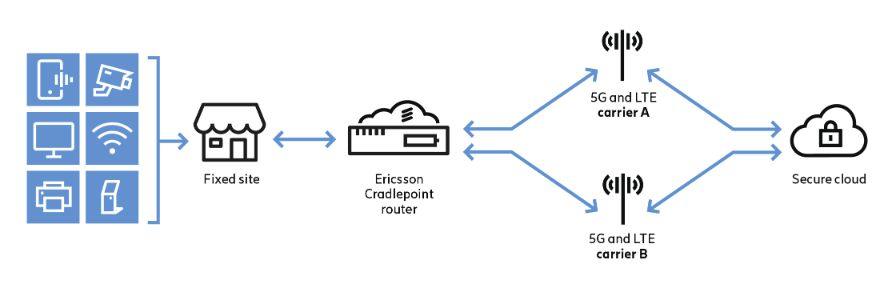
    Network Resilience: ericsson 5g failover routers

    Reasons and methods for utilizing cellular technology in stationary sites

    Cellular goes where wires can’t: Rural areas or newly developed regions might lack access to fiber, T1 lines, or other wired connections, resulting in pockets of disconnection even within urban and suburban areas. Networks that prioritize cellular or rely solely on wireless technology offer broad coverage and connectivity through advanced 5G and LTE networks. Companies can benefit from WAN link diversity by utilizing Ericsson Cradlepoint hybrid WAN routers, which accommodate multiple modems and carriers. If one carrier experiences a signal loss or decreased performance, another can automatically take over, ensuring seamless wireless-to-wireless WAN failover.

    Connect on day 1 and avoid delays: Wired networks necessitate careful planning and implementation, often leading to delays as companies and their staff await delayed installation services. In contrast, wireless connectivity via an Ericsson Cradlepoint router allows businesses to adapt, shift, and grow quickly. Instead of enduring the expenses and setup associated with cable installations, 5G and LTE networks can be activated immediately upon unboxing.

    Manage performance and security from anywhere: Branch offices do not have in-person IT specialists available. Rather than relying on external truck visits or corporate travel for network modifications and problem-solving, streamlined IT teams utilize Ericsson NetCloud Manager to enable, oversee, and diagnose hundreds of wireless routers from a unified interface—encompassing SD-WAN and enhanced security measures.

    Pop-up connectivity for temporary locations

    Temporary locations enable organizations to engage with customers and conduct business in creative ways, including seasonal shops, tax preparation offices, election polling sites, and emergency response tents. However, wired internet access is frequently either unavailable or prohibitively costly for these pop-up scenarios.

    Utilize Ericsson’s enterprise wireless offerings — including cellular routers equipped with scalable security features like zero trust networking and hybrid mesh firewall — to quickly establish cellular connections as the main WAN link at temporary sites, particularly in scenarios where wired connectivity is prohibitively costly or unreliable.
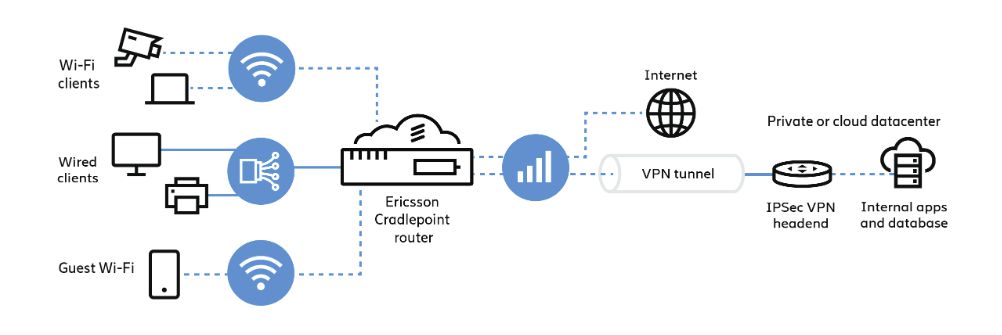
    Network Resilience: popup sites using 5g routers

    Key factors for pop-up networks at temporary sites

    On-demand connectivity and security anywhere: Organizations can quickly establish adaptable and secure cellular WAN connections and deploy Wi-Fi on demand using plug-and-play cellular routers, eliminating the need for IT personnel to be present on-site. The flexibility of cellular technology enables businesses to relocate their temporary solutions as required, while scalable security measures can be modified at any moment.

    Ensure predictable costs, no matter the area: Utilizing mobile connectivity for temporary networking standardizes wide area network (WAN) expenses nationwide, allowing reliance on one or two network carriers rather than needing a separate wired internet service provider in each city.

    Zero-touch deployment with centralized management; Ericsson’s offerings feature zero-touch deployment, as every router is registered in Ericsson NetCloud prior to shipment. This allows organizations to establish pop-up connectivity swiftly and without the need to dispatch an IT expert to the location. After deployment, the oversight and administration of all connection and security settings can be managed remotely via NetCloud Manager.

    Cellular failover and out-of-band management

    Gartner approximates that each hour of internet outage results in an average loss of $300,000 for enterprise organizations. Such downtime can bring business operations to a standstill by disrupting access to essential devices and applications, including point of sale systems, inventory management, data storage, and communication tools.

    Harness the power of an Ericsson Cradlepoint adapter or router to enhance the reliability of your primary wired router located in a fixed position. This innovative solution not only offers cellular failover but also enables seamless wireless out-of-band management. With smart policies in place, traffic can swiftly reroute through the wireless connection whenever the primary wired link faces interruptions. When the wired connection is back online, the traffic flow effortlessly resumes to normal — often without users or customers even realizing it. 
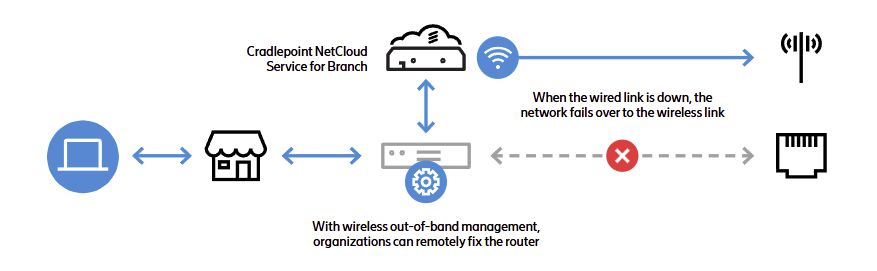
    Benefitting from cellular failover and out-of-band management

    Seamless automatic cellular failover: While traditional wired failover relies on the same last-mile trenches and backhaul routes, a Wireless WAN connection opens up exciting new possibilities by utilizing diverse air pathways. This innovative approach enables policies to swiftly route traffic over a 5G or LTE link at a moment’s notice. With automatic failover and WAN redundancy, you can enjoy dependable uptime for networks where constant connectivity is essential. 

    Remote visibility into primary hardware failure: By establishing a direct link from the adapter’s console port to the main router, administrators gain the ability to access the router wirelessly, regardless of whether the IP and Ethernet are operational. This innovative approach allows for efficient remote troubleshooting, eliminating the need for costly truck rolls or sluggish, expensive POTS lines.

    Manage and monitor connections from anywhere: Rather than depending on external visits or business travel for network repairs, streamlined IT teams can utilize Ericsson NetCloud Manager to enable, oversee, and diagnose routers and adapters. These remote management features are consolidated into one interface, ensuring connections remain active and minimizing the workload for staff.

    Cellular for day-1 connectivity in long-term locations

    Organizations that frequently launch sites with tight timelines—driven by revenue targets and business objectives—often cannot afford to delay the installation of wired connections. They require immediate secure access so that their staff can get ready and operations can start on the scheduled opening day.

    Utilizing Ericsson’s enterprise wireless offerings—comprising cellular-enabled routers and adapters integrated with SD-WAN services—to enhance the effective use of various WAN connections and security measures like zero trust networking and IDS/IPS. This enables you to quickly establish cellular connectivity as the main WAN link at a new or relocated site, particularly during the interim period before wired connections are installed. Once wired connectivity becomes available, you can modify the setup (switching cellular to failover, primary, etc.) as required.
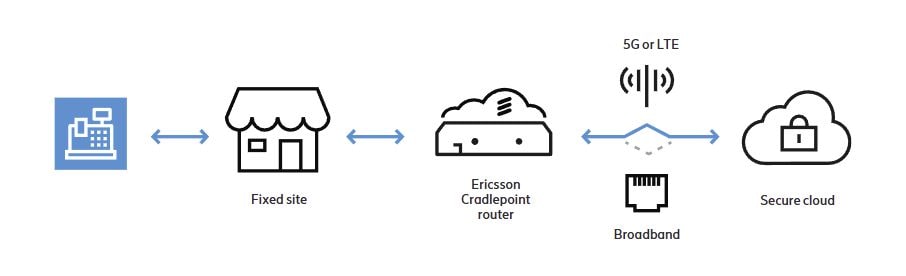
    Key factors for a successful day-1 connectivity solution

    Immediate connectivity through cellular: Ericsson Cradlepoint’s all-in-one routers come with integrated high-performance 5G or LTE modems, removing the necessity to wait for wired connections. These routers create a secure cellular link as the main connection, ensuring immediate connectivity at new sites. Companies can launch on time, free from network-related delays.

    Support of multiple types of WAN and LAN connections: Ericsson’s wireless solutions for enterprises are designed with adaptability as a key focus. The routers accommodate a range of WAN and LAN connection types, such as cellular, wired broadband, fiber, and satellite. This flexibility enables companies to choose the most appropriate option tailored to their unique requirements. The multi-WAN functionalities and SD-WAN capabilities allow organizations to manage network traffic across various WAN connections, ensuring enhanced performance, redundancy, and increased bandwidth.

    Scalable security: With Ericsson NetCloud, companies can enhance their network security by utilizing a unified platform. Organizations can establish a zero trust network by implementing Ericsson NetCloud SASE, which eliminates the need for outdated VPNs by offering perimeterless, “invitation-only” access. Name-based routing minimizes the potential attack surface, while cloud-based orchestration simplifies management. Additionally, incorporating a hybrid mesh firewall with web filtering and IDS/IPS safeguards against online threats.

    Using Secure 5G and SD-WAN Through a Hybrid WAN Solution in Fixed Sites

    In retail locations, workplaces, and various permanent sites, the ongoing introduction of IoT devices, remote employees, cloud applications, and direct Internet connectivity has heightened the need for dependable and flexible networks. Companies frequently require branch routers capable of utilizing various WAN and LAN resources, offering enhanced network security and performance capabilities than ever before.
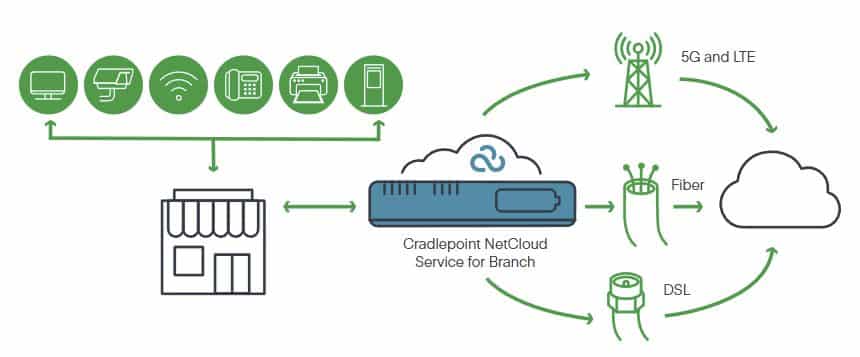
    Benefits of hybrid WAN solutions

    Multiple WAN and LAN options through one solution: Cradlepoint’s comprehensive hybrid WAN routers harness the capabilities of 5G and LTE—featuring compatibility with several modems and service providers—while also delivering Wi-Fi, accommodating wired connections, and enabling Bluetooth support.
    Built-in layers of network security: Cradlepoint’s hybrid WAN offerings for stationary locations include a zone-focused and application-sensitive firewall, along with content filtering and intrusion prevention/detection systems (IPS/IDS). Additionally, they provide supplementary services such as zero trust networking. These solutions allow web, SaaS, and cloud traffic to connect straight to the Internet without requiring extra devices or management systems.
    SD-WAN features for better application uptime and performance: Implementing business policies to automate route selection and enhance network traffic is essential for companies that cannot tolerate disruptions in specific applications caused by inconsistent signal strength or increased latency.
    Centralized control of network connectivity and security at many sites:  When managing extensive locations, IT teams utilize Cradlepoint NetCloud Manager to centrally oversee, control, and resolve issues related to network availability and performance, as well as data protection—resulting in savings of up to hundreds of thousands of dollars in time and costs annually.

    Conclusion

    By leveraging 5G IoT Solutions this can be your secret weapon against unexpected outages. By embracing this innovative solution you can stay ahead of the competition, ensuring your business remains resilient and thriving in every moment.  Find out more by contacting us today!